Pachelbel’s String Compositions
Pachelbel’s String Compositions
Johann Pachelbel’s compositions for string instruments occupy a distinct position in Late Baroque music. While widely known today for a single piece, his string oeuvre represents a bridge between earlier 17th-century German polyphonic traditions and the refined, Italianate suite styles that influenced early 18th-century developments (Nolte & Butt, 2001).
Style and Harmonic Framework
Unlike his North German contemporaries who favored unpredictable structural forms, Pachelbel’s string writing is characterized by formal clarity, harmonic predictability, and dense counterpoint:
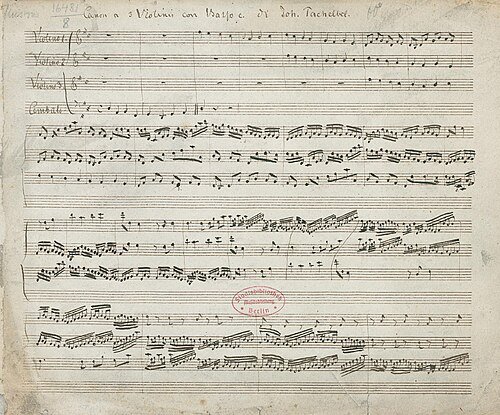
- Ground Bass and Ostinato: His string compositions frequently rely on repeated bass patterns. The Canon and Gigue in D Major (P.37) utilizes an eight-note ground bass that repeats 28 times, serving as a structural anchor while the three upper violin parts weave complex contrapuntal variations above it.
- Equal-Voice Counterpoint: Rather than treating a single instrument as a soloist, Pachelbel’s chamber string music treats the upper string lines as absolute equals, engaging in strict imitation at the unison.
Key Works for String Ensembles
Beyond the Canon and Gigue in D Major (originally scored for three violins and basso continuo), Pachelbel’s primary legacy in string chamber music rests on a published collection:
- Musicalische Ergötzung (Musical Delight, c. 1699): A published collection containing six chamber suites (Partitias) scored for two violins and basso continuo (Welter, 1998).
- Scordatura Tuning: In Musicalische Ergötzung, Pachelbel utilized scordatura (an intentional alternative tuning of the violin strings). As noted in musicological studies of the era, Pachelbel used this technique systematically to explore distinct tonal colors and facilitate double-stops for ensemble players (Glüxam, 1999).
- Suite Form: Each suite in the collection follows a sequence of stylized dances (such as the Allemande, Courante, Sarabande, and Gigue), blending rigorous German contrapuntal technique with French and Italian dance forms.
Historical Context and Reception
In his lifetime, Pachelbel was celebrated primarily as an organist and composer of sacred keyboard works in Nuremberg and Erfurt. His chamber music for strings was written largely for private civic functions or instructional ensemble work.
Following his death in 1706, his string chamber music fell into obscurity until the 20th century. A 1968 arrangement and recording by the Jean-François Paillard Chamber Orchestra brought the Canon in D into widespread public prominence, cementing its place in modern popular culture and classical repertoire.
References
- Glüxam, D. (1999). Die Violinskordatur und ihre Rolle in der Geschichte des Violinspiels. Hans Schneider.
- Nolte, E. V., & Butt, J. (2001). Pachelbel, Johann. In S. Sadie & J. Tyrrell (Eds.), The New Grove Dictionary of Music and Musicians (2nd ed.). Macmillan Publishers.
- Welter, K. J. (1998). Johann Pachelbel: Organist, Teacher, Composer. A Critical Reexamination of His Life, Works, and Historical Significance [Doctoral dissertation, Harvard University].